
Nomiki Petrolla
·5 min read
Solo founder and CEO of Theanna, the equity-free platform for non-technical women building tech startups. $218,206 ARR. Building in public, sharing the wins and the losses along the way.
The journey to $1M ARR
As of March 21, 2026
22% there
I’ve made a lot of mistakes building Theanna. But this five-month stretch almost broke me. Here’s the full story — the bad hire, the broken DNS, and the graph that kept going down.
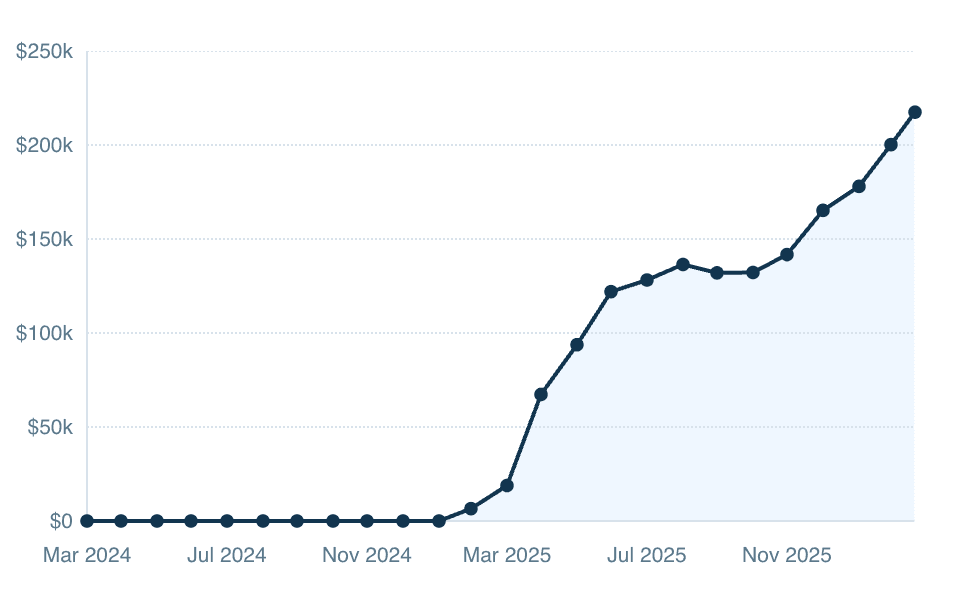
Let me show you something. If you look at my growth graph from launch to today, it looks great. Up and to the right. $0 to $218K ARR in a year. But if you zoom in, there’s a section in the middle that tells a very different story.
Three months after launching, I hit about $7K MRR. That’s fast. I was on fire. Then for the next five months, the line went down. Slowly. Steadily. I lost roughly $25,000 in ARR during that stretch. And for most of it, I had no idea why.
What’s in This Post
- This Is What a Bad Hire Can Do to Your Business
- The DNS Problem I Didn’t Know About
- The Grind Nobody Sees
- The Recovery
This is what a bad hire can do to your business
A few months in, I brought someone on to help with architecture, cybersecurity, and agentic AI. On paper, it made sense. In practice, it was a disaster.
We are both alpha personalities. That’s the nicest way I can put it. Within three weeks I knew this person was not right for the company. The values didn’t align. The way they operated didn’t align. I found out things about how they were handling our code that made my stomach turn.
Here’s the thing: it is your job to notice it. Nobody else is going to tap you on the shoulder and tell you this person is wrong for your company. You have to see it, and then you have to act on it fast. Every day you wait is a day your business is bleeding momentum. I should have cut it in week one. I waited three weeks. That was too long.
When you bring the wrong person into your company early, the damage is not just the time you lose. It’s the momentum. I was moving fast. I had customers coming in. I was shipping. And then I had to stop everything to deal with a personnel crisis instead of building my business.
The lesson was clear: notice faster, decide faster, move forward faster. A bad hire at the early stage can stall your entire company. The sooner you recognize it, the sooner you get back to building.
“It is your job to notice when something is wrong. And it is your job to make the decision fast. Every day you wait is a day your business pays for it.”
The DNS problem I didn’t know about
While all of this was happening, something else was going wrong that I couldn’t see.
During a stretch of fast testing and iteration, our DNS records got mismatched. I won’t bore you with the technical details, but the result was simple: my emails stopped being delivered. Not all at once. That’s the cruel part. It was a slow trickle. Emails were going to spam. Some weren’t arriving at all. Leads were falling through. Customers weren’t getting onboarded properly.
I didn’t catch it right away because the drop was gradual. It’s not like one day everything stopped. It was more like — why are the numbers down this week? And then the next week. And then the next. I was looking at churn, looking at my funnel, looking at my content, trying to figure out what I was doing wrong. The whole time it was a technical problem hiding underneath everything.
When I finally figured out the DNS was broken, I felt two things at once: relief that I found the problem, and fury that it had been silently killing my business for months.
“The scariest problems in a startup are not the ones that blow up. They’re the ones that leak. Slowly. Quietly. Until you look at the numbers and realize something has been wrong for months.”
The grind nobody sees
Here’s what those five months actually felt like. I was watching my numbers decline and I could not figure out why. I was working harder than ever — more content, more outreach, more everything — and the graph kept going down.
That is the loneliest feeling in entrepreneurship. When you are doing everything right and the results are getting worse. You start questioning yourself. Am I bad at this? Is the product broken? Did I miss something fundamental? The answer was none of the above. But I didn’t know that yet.
So I just kept grinding. I didn’t stop. I didn’t slow down. I kept showing up every single day and doing the work even when the numbers made no sense. That is the part of entrepreneurship nobody posts about. The stretch where you are doing everything right and it still looks like it’s not working.
I think a lot of founders hit this exact moment and quit. The numbers dip. You can’t explain it. You assume it’s you. And you walk away from something that might have been one DNS fix away from recovering.
“The hardest part of building a company is not the work. It’s doing the work when the results don’t match the effort.”
The recovery
I fixed the DNS. I cut the bad hire. And then I did the only thing I know how to do: I kept going.
The graph turned around. Not overnight. But once the emails were delivering again and I was back to building without a personnel fire burning in the background, the numbers started climbing. The customers came back. New ones showed up. The line went back up.
If you look at my growth chart today, that five-month dip is just a valley in the middle of an upward line. It looks like a blip. It did not feel like a blip. It felt like the end.
But it wasn’t. And here’s what I need every founder reading this to hear: don’t quit. Do not quit. You never know what’s on the other side of that dumpster fire. For me, it was $218K ARR and 300+ women founders building companies. The other side was everything I wanted. I just had to survive the middle.
“Don’t quit. You never know what’s on the other side of that dumpster fire.”
Would I go through it again? I’d rather not. But would I trade what came after? Not for anything.
— Nomiki
Join 300+ women founders
Ready to start building?
AI tools, founder community, engineering support, and a structured framework to go from idea to paying customers.
More posts